
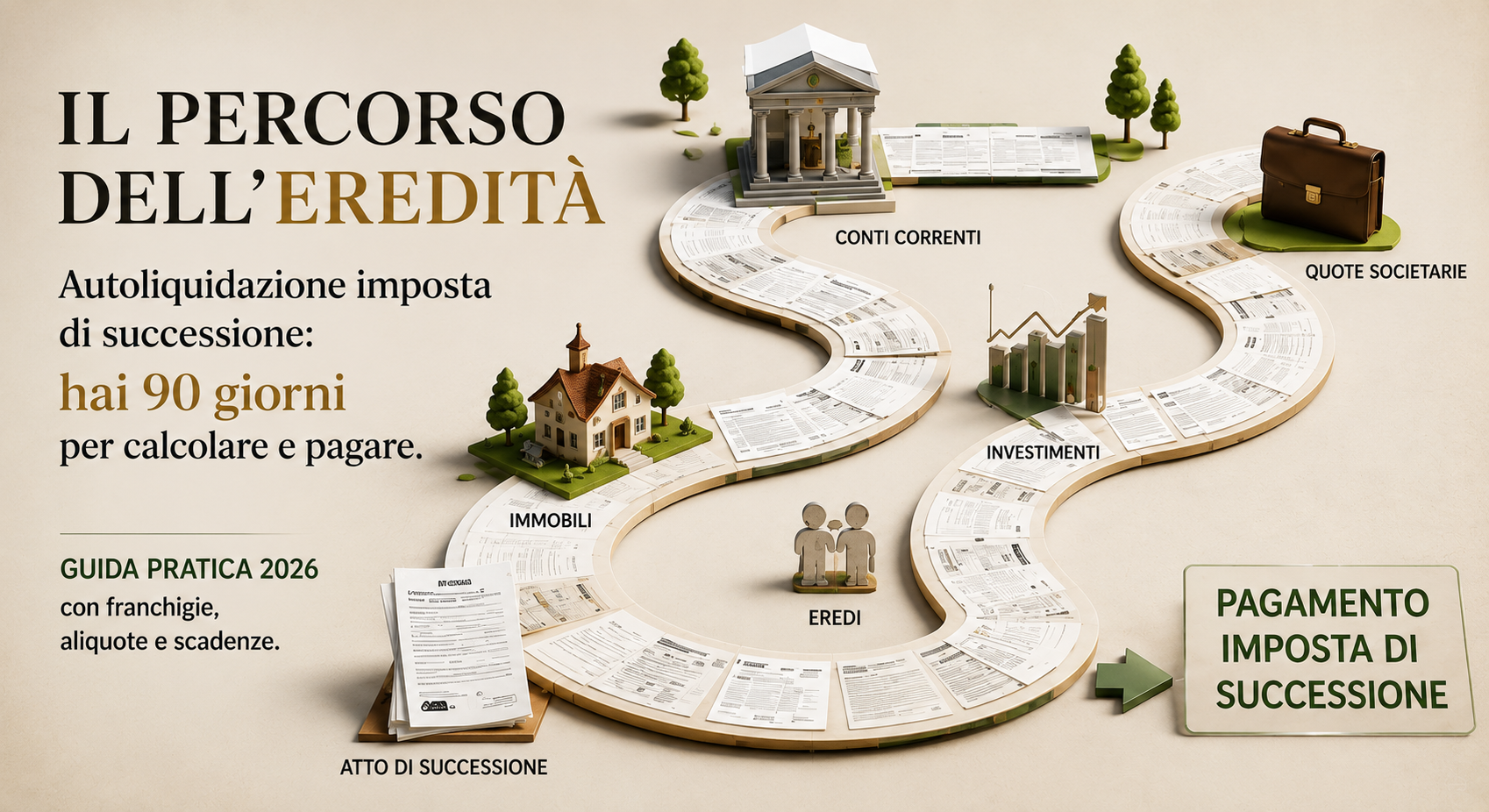

Did you open an inheritance tax return in 2026 and were told to "calculate and pay the tax yourself"? It's not a mistake: it's the standard procedure. For over a year,self-assessment of inheritance tax —introduced by Legislative Decree 139/2024 and effective January 1, 2025—has been the standard regime for anyone filing an inheritance tax return in Italy. Yet, many families arrive at the point of filing unaware that there are 90 days to calculate and pay the tax, that incorrect calculations expose them to penalties, and that property valuation rules can make a significant difference to the final amount. This guide explains how it works in practice, without unnecessary technicalities.
What isself-assessment of inheritance tax
Before the reform, the process was different: the taxpayer filed the inheritance tax return, and then the Revenue Agency assessed the tax, issuing a payment notice to which the taxpayer responded by paying. It was a passive process, in which the citizen waited.
With self-assessment of inheritance tax, the system is reversed: the taxpayer—assisted by their own professionals—calculates and pays the tax due, without waiting for any notification from the Agency. The model followed is the one already used for mortgage and land registry taxes, which have been self-assessed for years. Now, the rules extend to the main inheritance tax.
How does self-assessment of inheritance tax work: deadlines
The operational steps are as follows:
1. Filing the inheritance tax return. The tax return must be filed electronically within 12 months of the opening of the inheritance (i.e., the date of death). The deadline has not changed compared to the past.
2. Calculating the tax due. Within 90 days of submitting the tax return electronically, the taxpayer is required to calculate and pay the self-assessed tax. There's no longer a wait for the Agency's notification: the tax is calculated—or has been calculated—automated, applying the rates and exemptions established by law.
3. Payment via F24 form. Payment is made using the electronic F24 form. Payment can be made in up to 8 quarterly installments if the tax exceeds €1,000.
Deductibles and rates: what you really pay
Inheritance tax is not always due. The law provides exemption thresholds (deductibles) below which nothing is paid:
- Spouse and children: €1,000,000 tax-free allowance for each beneficiary; 4% tax rate on the excess
- Brothers and sisters: €100,000 tax-free allowance for each; 6% tax rate on the excess
- Other relatives up to the 4th degree: no tax exemption; 6%
- Other subjects: no tax exemption;8%
- People with severe disabilities (L. 104/1992): tax-free allowance of 1,500,000 euros, regardless of the degree of kinship
For real estate, the taxable base is determined by the cadastral value—not the market value—with the coefficients established by law. This is an often overlooked factor that can significantly reduce the final tax.
The risks of an incorrect calculation: penalties and interest
Self-assessment involves direct liability: if the calculation is incorrect or the payment is insufficient, penalties and interest apply. The system provides:
- Supplementary liquidation by the Revenue Agency if it detects errors in the taxpayer's calculations
- 30% penalty on unpaid tax, reducible with effective repentance
- Legal interest on late payment
For this reason, professional support during the calculation phase is not an optional extra: it guarantees that the 90 days required by law are managed correctly, without incurring unnecessary additional costs.
The role of the notary in the declaration of succession
The inheritance declaration requires the collection of extensive documentation: property deeds of origin, land registry records, bank account balances at the date of death, insurance policies, company shares, and deductible debts. Each asset category follows specific valuation rules. At our firm, we assist heirs in preparing the complete declaration, calculating the self-assessment tax, and ensuring payment is made on time, coordinating all necessary information so that the inheritance proceeds without errors or delays.
The official instructions for completing the electronic inheritance tax return are available on theRevenue Agency.
Something new to know, not to fear
Self-assessment is not, in itself, a disadvantage for the taxpayer. On the contrary, it eliminates long and often unpredictable waiting times, clarifies from the outset how much must be paid, and allows for advance planning of the necessary liquidity. This paradigm shift, however, requires that heirs be timely and well-supported from the very first months after the opening of the estate—before the 90-day period ends.
Are you managing a succession?
Self-assessment of inheritance tax is a new procedure, with precise deadlines and calculations that require careful attention. At our notary office, we guide heirs through every step: from gathering documents to calculating the tax, from making the payment on time to signing the deed of acceptance of the inheritance or division of the estate. If you have recently opened an inheritance—or are about to—contact us immediately at +39 06.807.0943 or fill out the form below: we'll help you avoid missing any deadlines.
