
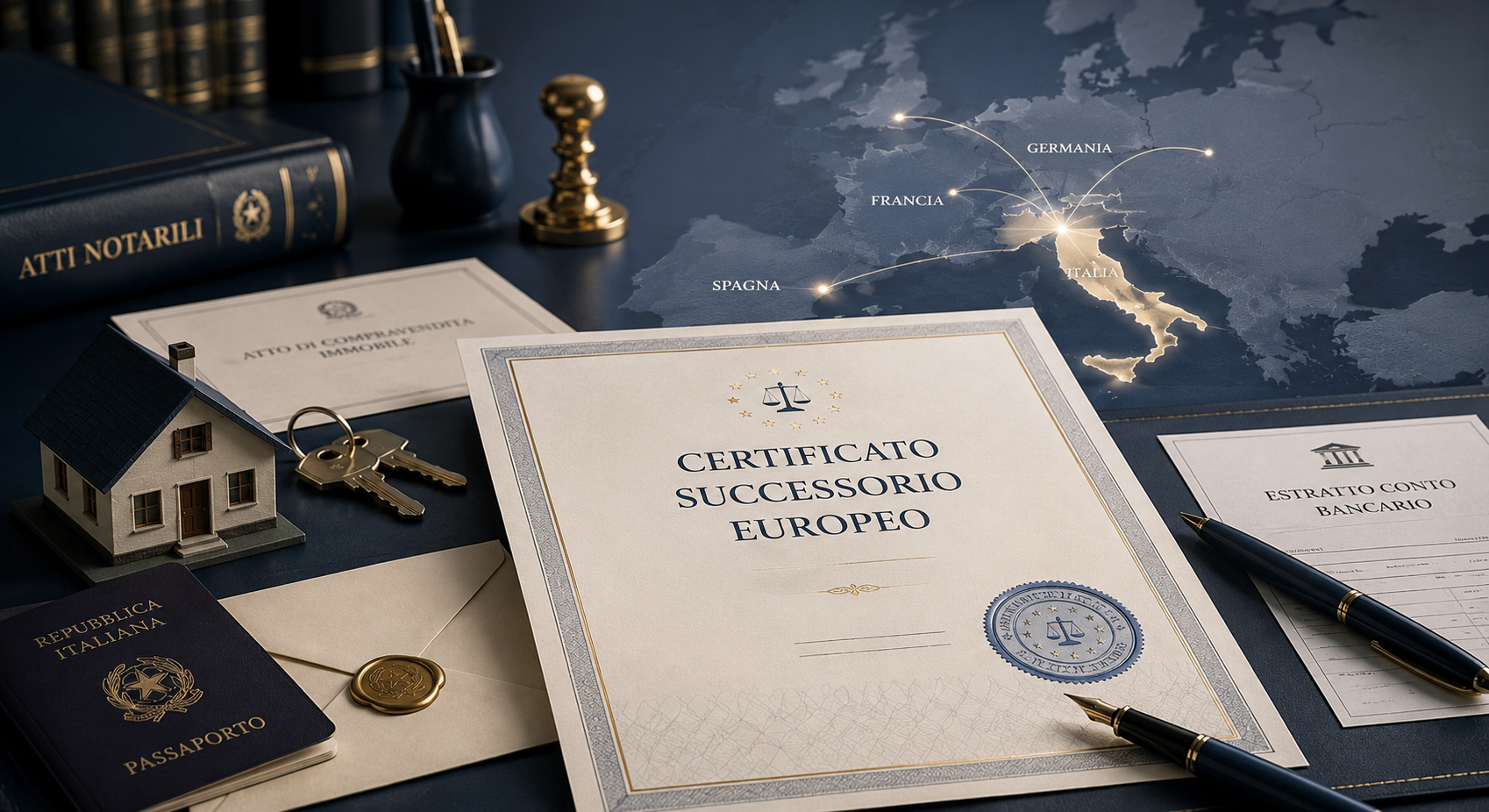

Have you inherited assets located in more than one European country? If a family member had a bank account in Germany, a house in France , or investments in Spain, you've probably already encountered a recurring question: which document proves my status as an heir abroad? The answer, in most cases, is the European Certificate of Succession.
The problem: increasingly frequent cross-border
mobilityhas made cross-border successions a daily reality for many Italian and foreign families residing in Italy. An Italian citizen with a property in London, a foreign professional with a bank account in Italy, a family with heirs spread across multiple member states: in all these cases, proving one's status as an heir or administrator of the estate becomes complex, because each country has its own succession rules and evidentiary documents.
The agitation: duplicate procedures, long waiting times, risk of asset freeze
Without a uniform instrument, the heir would be forced to initiate separate procedures in each country where the inherited assets are located , with concrete consequences:
- Bank account unblocking times are taking months to unblock.
- Duplicate legal costs to obtain equivalent documents in different
- Risk of disputes by banks, land registry offices or other foreign authorities that do not recognize Italian documentation
- Coordination difficulties when the heirs are citizens of different
The solution: the European Certificate of Succession
Introducedby Regulation No. 650/2012, the European Certificate of Succession is a document recognised in all Member States of the European Union (except Denmark and Ireland), which certifies:
- the quality of heir, legatee or executor
- the powers of administration of the inheritance
- the share of the inheritance attributed to each heir
The main advantage? Once issued, the Certificate is automatically effective in all other EU countries, without the need for further recognition procedures.
How to get it
The Certificate is issued by the competent authority of the country in which the deceased had their habitual residence at the time of death. In Italy, this is the responsibility of the notary, who:
- Check the law applicable to the succession (usually that of the State of habitual residence of the deceased, unless expressly chosen during life)
- Collect the necessary documentation ( death certificate, will, if applicable, family status, documents on assets abroad)
- Drafts the application and forwards it to the competent authority
- It takes care of issuing the Certificate, valid for a limited period (generally renewable)
An often overlooked point
The European Certificate of Succession does not replace instruments (such as the Italian declaration of succession), but rather complements: it is specifically designed for use in another Member State, while for assets located in Italy, the requirements set out in Italian law remain necessary.
Why you should hire a notary with international experience?
Managing an estate with assets in multiple countries requires the ability to coordinate different regulations, communicate with foreign authorities, and often work in English with non-Italian heirs or professionals. This is an area where specific experience makes the difference between a smooth process and months of stagnation.
Do you have an estate with assets abroad or heirs residing outside of Italy? Notary Federica Spinaci assists Italian and foreign individuals and families in managing cross-border estates , also providing dedicated assistance in English.
Call +39 06.807.0943 orfill out the form below to book a personalized consultation.
